
Featured Analysis

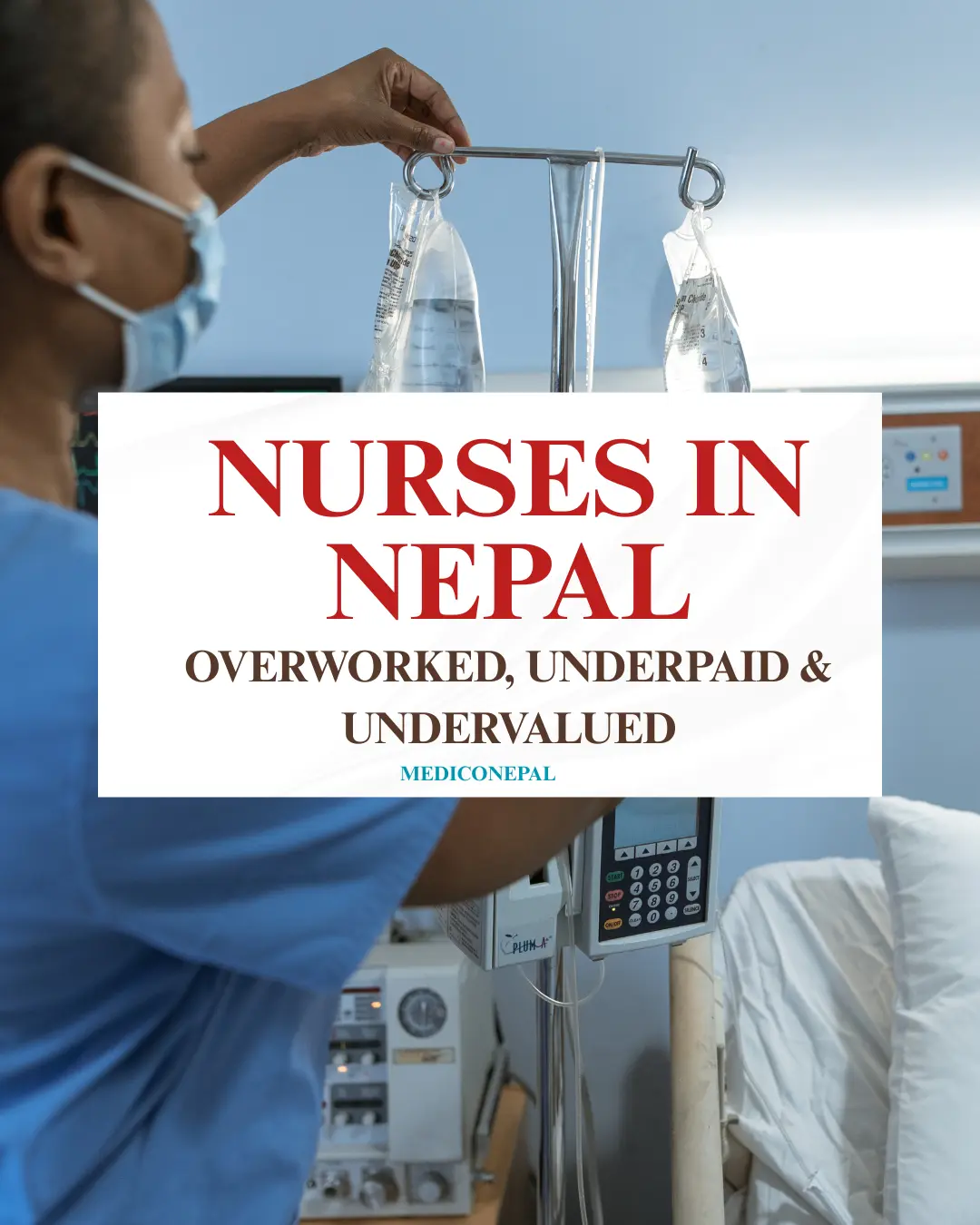
Nurses in Nepal:
Overworked, Underpaid & Undervalued

The profession that keeps Nepal's healthcare system running is increasingly struggling to keep its own workforce afloat. Every day, nurses stand at the frontline of Nepal's healthcare system. They monitor critically ill patients through the night, comfort anxious families, administer life-saving treatment, respond first during medical emergencies, and remain beside patients long after doctors have left the ward. Their work demands technical expertise, emotional resilience, and unwavering commitment.

Yet, behind the image of nursing as a "noble profession" lies a reality that has become increasingly difficult to ignore. Across Nepal, thousands of nurses describe a profession marked by long working hours, low wages, inadequate job protection, limited professional recognition, and growing emotional exhaustion. These conditions have not only triggered nationwide protests time and then but are also driving an unprecedented migration of trained nurses abroad, raising concerns about the future of Nepal's healthcare workforce.

8 min read
MedicoNepal
2083 Ashadh 16
Editorial
Why Young Doctors Are Leaving Nepal

A Profession Built on Care, But Sustained by Sacrifice:

International Nurses Day is often celebrated with messages recognising nurses as the backbone of healthcare. In 2026, the global theme, "Our Nurses, Our Future; Empowered Nurses Save Lives," highlighted the importance of investing in the profession. For many nurses in Nepal, however, the message contrasted sharply with their lived reality. The reality is that nursing in nepal is a profession increasingly defined not by celebration but by exhaustion. Many nurses have invested years of education and significant financial resources into their careers, only to enter workplaces where wages remain low, workplace protections are inadequate, and professional respect often falls short of expectations.

Nurses care for others while struggling to secure their own financial stability, health protection, and dignity at work. The profession can no longer rely on the expectation that nurses should silently endure every hardship in the name of service. Rather than symbolic appreciation once a year, meaningful improvements in safety, fair wages, workplace protection, and recognition should be celebrated.

The Economics of Nursing No Longer Add Up:

The financial reality of nursing in Nepal has become one of the profession's most pressing challenges. Several reports indicate that nurses working in private hospitals have earned as little as Rs15,000 to Rs20,000 per month, despite completing years of education and professional training. Former Nursing Association of Nepal president Tara Pokharel has noted that many students invest Rs800,000 to Rs10 Lakhs in nursing education before entering jobs that offer salaries barely sufficient to meet basic living expenses.

Some nurses interviewed by national media described earning Rs18,000 per month after years of hospital experience, saying that even routine household expenses required careful budgeting. Others explained that despite permanent government positions offering comparatively better salaries, opportunities remain limited, leaving many graduates dependent on private sector employment where wages are significantly lower.

According to the Nepal Nursing Association, there have also been complaints that some hospitals delayed salary payments for months, further worsening financial insecurity. The contrast between educational investment and professional earnings has increasingly led nurses to question whether remaining in Nepal is financially sustainable.

Heavy Workloads, Limited Protection:

Compensation is only one part of the problem. Reports consistently describe demanding working conditions characterised by long shifts, staffing shortages, inadequate benefits, and limited workplace protections. One intensive care nurse interviewed by Reuters described being responsible for three critically ill patients simultaneously, despite international standards generally recommending one nurse per ICU patient. She characterised the workload as exploitative, questioning the sustainability of remaining in a system where professional demands continue to increase without corresponding support.

Investigative reports have similarly highlighted that nurses in private hospitals often work extended hours while receiving limited overtime compensation or additional benefits. During the Covid-19 pandemic, nurses continued providing essential care under extraordinary pressure, yet reports indicate many later experienced delayed salaries, layoffs, or continued financial insecurity once the immediate crisis subsided. Beyond physical demands, nurses also describe a significant emotional burden. Caring for critically ill patients, witnessing death, supporting families, and maintaining composure during emergencies require constant emotional labour that often goes unrecognised.

Protests That Brought Long-Ignored Problems Into Public View:

Years of frustration eventually culminated in nationwide protests during 2025. The movement began in Pokhara, where nurses at Manipal Teaching Hospital and Gandaki Medical College demanded salaries comparable to those received by government nurses. The protests quickly spread to hospitals across Nepal, including Biratnagar, Kathmandu, Dhangadhi, and other major cities. Nurses wore black armbands, organised demonstrations, and temporarily suspended services as part of their campaign. Supported by the Nursing Association of Nepal, they presented a 15-point charter of demands calling for fair wages, improved service conditions, better benefits, and payment structures aligned with government standards.

At the centre of the dispute was salary disparity. Many protesting nurses reported earning between Rs15,000 and Rs20,000 per month, while demanding implementation of the government's minimum salary standard of Rs34,730 for fifth-level nurses. Protest leaders argued that healthcare professionals who undergo years of education, clinical training, and licensing should not receive wages comparable to unskilled labour.

Hospital operators, however, maintained that matching government salary scales would be financially difficult for many private institutions. As negotiations continued, some hospitals discharged patients, suspended new admissions, or referred patients elsewhere, increasing pressure on nearby public hospitals. The dispute also affected insured patients relying on private hospitals participating in Nepal's Health Insurance Programme.

Agreements, Committees and Continuing Questions:

Following sustained demonstrations, the Ministry of Health and Population initiated negotiations between nursing representatives and private hospital operators. A task force was formed to examine nurses' concerns regarding salaries, working conditions, and benefits. Eventually, an agreement was reached under which larger private hospitals and medical colleges committed to providing salaries equivalent to government standards, while other hospitals agreed to gradually implement a percentage of those salaries. The agreement also stated that hospitals already paying above government scales would not reduce existing benefits.

Despite the breakthrough, some nurses expressed dissatisfaction, arguing that previous agreements had not always been fully implemented. Others emphasised that salary alone would not resolve broader concerns surrounding workload, workplace safety, professional dignity, career progression, and legal protections.

The negotiations therefore represented an important milestone but not necessarily a final resolution.

Other analysis similarly suggests that limited postgraduate programmes encourage graduates to prepare for examinations such as the USMLE, PLAB, and the Australian Medical Council (AMC) examinations, creating pathways toward specialist training and eventual employment overseas.

An Accelerating Exodus:

Perhaps the clearest indicator of dissatisfaction within Nepal's nursing profession is the growing number of nurses leaving the country. According to data from the Nepal Nursing Council, more than 52,000 Nepali nurses had migrated abroad since 2002 by early 2026. The United States hosts the largest number, followed by Australia, the United Arab Emirates, Denmark, the United Kingdom, and Canada. Council records show Nepali nurses have migrated to at least 17 countries. The trend has accelerated in recent years. Around 4,000 nurses reportedly moved to the United States during fiscal year 2021–22, increasing to approximately 6,000 in 2023–24. Government projections and earlier ministry data similarly point to tens of thousands of nurses obtaining documentation required for overseas employment over the past two decades.

Interviews with migrant nurses consistently identify similar motivations. Higher salaries, organised healthcare systems, professional respect, career advancement, better technology, stronger job security, and clearer opportunities for professional development continue to attract nurses overseas. One nurse who previously earned Rs18,000 monthly in Pokhara explained that after relocating to Australia, financial concerns no longer dictated every family decision. Another nurse working in the United States described gaining confidence through access to modern healthcare systems and greater professional recognition. Health Ministry officials have acknowledged that global demand, easier migration pathways, and better long-term prospects continue to encourage overseas employment.

Nepal's Growing Workforce Shortage:

As more nurses leave, Nepal faces mounting concerns over workforce shortages. According to Ministry of Health data published in 2025, approximately 50,500 nurses were working in Nepal despite an estimated requirement exceeding 65,000, leaving a shortage of nearly 15,000 nurses. The ministry projects that Nepal will require around 81,000 nurses by 2030. At the same time, experts warn that the country's ability to produce sufficient new nurses may become increasingly constrained. The transition from the previous PCL Nursing programme to the new General Nursing programme has generated debate among education and health sector stakeholders. Concerns include stricter academic eligibility requirements, infrastructure standards requiring colleges to operate larger hospitals, and the possibility of reduced nursing graduates during the transition period.

These workforce concerns extend beyond hospital staffing. Government officials have noted challenges in recruiting nurses for community health and school nursing programmes, while international organisations continue to identify Nepal among countries experiencing significant shortages of healthcare workers.

Several officials, including representatives from the Council for Technical Education and Vocational Training (CTEVT) and the Nepal Nursing Council, have argued that further research and stronger legal preparation are necessary before implementing major educational reforms.

Beyond Salary: The Question of Value

Although wages dominate public discussion, the broader debate centres on how Nepal values its nursing workforce. Many nurses argue that recognition cannot be measured solely by ceremonial appreciation or annual celebrations. Professional respect is reflected in fair compensation, safe working conditions, career opportunities, legal protections, manageable workloads, and policies that allow nurses to build stable lives within their own country. The continued failure to address these issues risks accelerating the departure of trained professionals at a time when Nepal already faces shortages across its healthcare system.

The consequences extend well beyond the nursing profession itself. Every experienced nurse who leaves represents years of education, clinical training, and practical expertise. Replacing that experience is neither immediate nor inexpensive. As migration increases and domestic shortages widen, patients, hospitals, and communities ultimately bear the cost.

A System at a Crossroads:

A British Medical Journal study found that among Institute of Medicine graduates, 36% had migrated abroad, 37% practiced in Kathmandu, while only 27% worked outside Kathmandu.

If the issues of low pay, inadequate protections, and limited professional opportunities remain unresolved, the steady outflow of nurses is likely to continue. For a healthcare system already facing workforce shortages, that may become one of its greatest long-term challenges.

Nepal's nurses have made their concerns unmistakably clear. They have marched in protest, negotiated with policymakers, spoken publicly about their experiences, and highlighted the gap between the responsibilities they shoulder and the conditions under which they work. Their demands are not limited to higher salaries. They encompass professional dignity, workplace safety, predictable career progression, timely payment, reasonable workloads, and meaningful recognition of the role nurses play within the healthcare system. The conversation surrounding nursing in Nepal is therefore no longer simply about employment conditions. It is about whether the country can retain the workforce upon which its health system depends.